Why Modular Avionics Will Define the Next Generation of Space Missions
An overview of how modular avionics reduce development risk, simplify spacecraft integration, and enable scalable, high-performance space systems for future missions.
For many years, spacecraft avionics were developed as mission-specific systems. Flight computers, power electronics, communications interfaces, and payload controllers were designed around a single mission with little expectation that the hardware would be reused. This approach worked well when spacecraft were produced in small quantities and missions were expected to operate largely unchanged throughout their lifetime. Today's environment is different. Government and commercial operators are fielding larger constellations, introducing new payloads at a faster pace, and expecting spacecraft to accommodate changing mission requirements without restarting the entire development process.
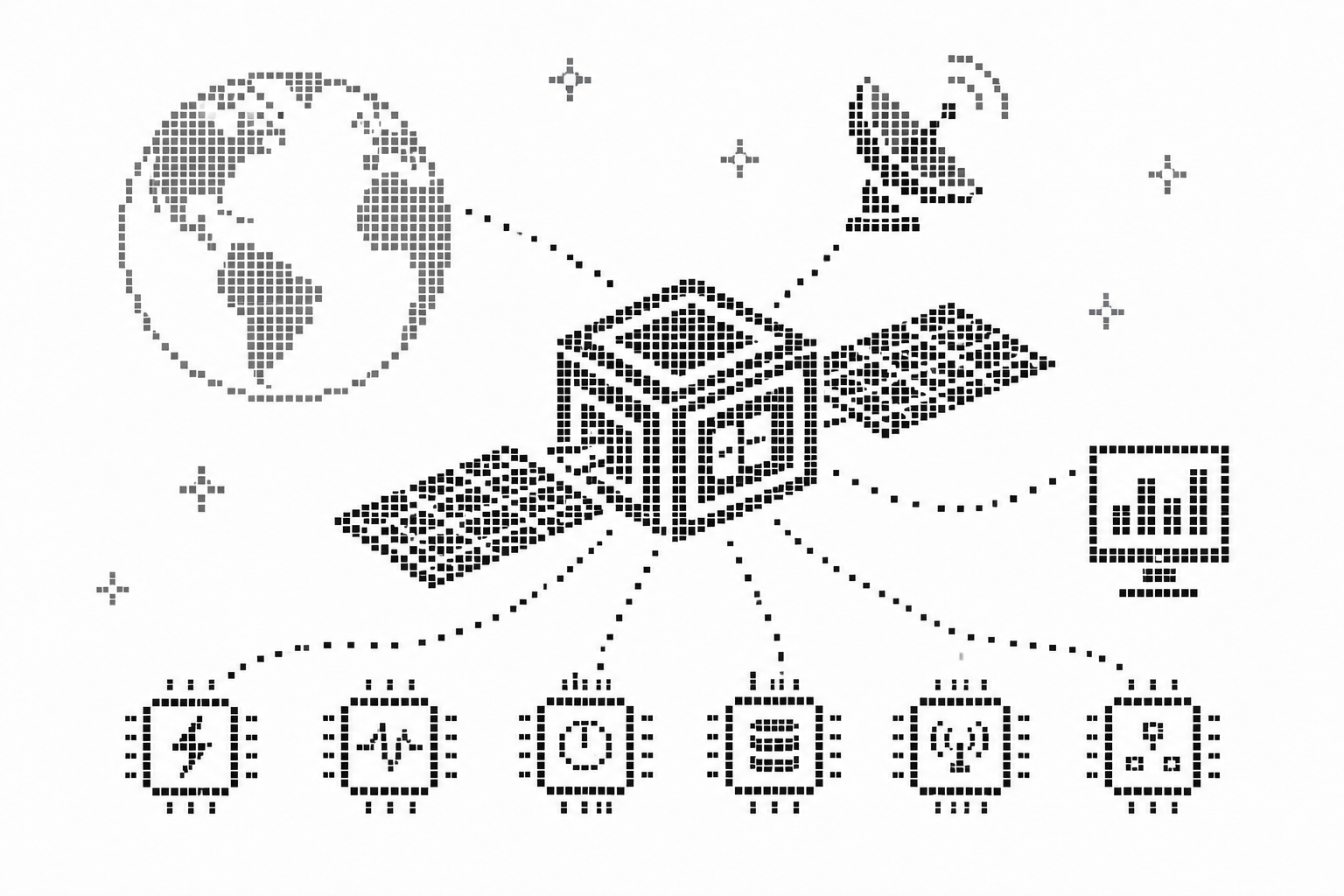
The result has been a shift toward modular avionics architectures. Instead of treating every spacecraft as a unique design, modular systems divide the avionics into independent functional elements such as flight computing, power distribution, timing, navigation, communications, payload interfaces, and high-speed data processing. Each module performs a defined function and communicates through standardized electrical and software interfaces. The objective is not simply to reuse hardware, but to reduce integration effort, simplify manufacturing, and provide a stable platform that can evolve as new technologies become available.
One of the most significant advantages of this approach is the reduction in non-recurring engineering. Common spacecraft functions change very little from one mission to the next. Power conversion, telemetry and command handling, housekeeping data collection, time synchronization, actuator control, and fault management are required on nearly every spacecraft regardless of the payload. Designing these functions repeatedly consumes engineering resources that could otherwise be directed toward mission-specific capabilities. Once these building blocks have been designed and qualified, they can support multiple spacecraft with only configuration changes rather than complete redesigns.
Modularity also changes how spacecraft are integrated and tested. Traditional spacecraft integration often requires multiple engineering teams to work simultaneously on tightly coupled hardware, making it difficult to isolate problems as they arise. With a modular architecture, individual assemblies can be verified independently before system integration. Flight computers can execute flight software while payload interface modules are tested separately. Power systems can be validated under representative electrical loads before the complete spacecraft is assembled. This staged verification process reduces integration risk and allows issues to be identified earlier in the program.
High-performance onboard processing has become another driver for modular architectures. Modern electro-optical, infrared, hyperspectral, synthetic aperture radar, and RF sensing payloads generate data at rates that can quickly exceed available downlink bandwidth. Rather than transmitting raw measurements to the ground, spacecraft increasingly perform image processing, signal conditioning, detection, tracking, compression, and data reduction onboard. This shifts computational demand from the ground segment to the spacecraft and requires significantly more processing capability than traditional flight computers were designed to provide. Modular compute architectures allow processing resources to be scaled by adding additional compute modules without redesigning the rest of the avionics.
The separation of mission computing from spacecraft control also improves system flexibility. Safety-critical spacecraft functions such as attitude control, propulsion management, thermal control, and fault protection can remain on deterministic flight hardware while computationally intensive payload processing executes on dedicated high-performance processors. This partitioning simplifies software development, reduces certification complexity, and allows mission processing hardware to evolve independently from the spacecraft control system.
Manufacturing benefits become increasingly important as constellation sizes grow. Building a handful of spacecraft allows considerable flexibility in design and assembly, but recurring production requires repeatable hardware, stable supply chains, and consistent manufacturing processes. Standardized avionics modules reduce the number of unique circuit card assemblies, simplify procurement, and enable common acceptance and environmental test procedures across multiple programs. Engineering changes are also easier to manage because updates to a single module can be introduced without affecting unrelated portions of the spacecraft.
Standardization also simplifies future technology insertion. Processors continue to increase in capability, communication interfaces evolve, and payload data rates continue to rise. A modular architecture allows individual avionics elements to be upgraded while maintaining compatibility with the remainder of the spacecraft. Instead of redesigning an entire avionics system every few years, only the modules that benefit from newer technology need to change. This protects previous engineering investment while allowing future spacecraft to incorporate improved capabilities with significantly lower development risk.
Modular avionics do not eliminate the engineering challenges associated with spacecraft development. Standardized interfaces must be carefully defined, electrical margins must accommodate multiple configurations, thermal management becomes more complex as processing density increases, and system timing must remain deterministic across distributed hardware. These considerations require additional architectural discipline early in a program. However, once established, they provide a foundation that supports multiple spacecraft, multiple payloads, and multiple mission types with substantially less engineering effort than traditional custom avionics.
As spacecraft continue to grow in capability while development schedules become shorter, modular avionics are becoming a practical engineering solution rather than simply an architectural preference. They reduce repeated design effort, simplify integration and manufacturing, support higher onboard processing performance, and provide a straightforward path for future upgrades. For organizations building recurring spacecraft or planning families of related missions, these advantages become increasingly valuable with every new vehicle that enters production.

Haytham Elmasri
An overview of how modular avionics reduce development risk, simplify spacecraft integration, and enable scalable, high-performance space systems for future missions.